1. Semantic Intent & Overview: The Strategic Role of Intramedullary Interlocking Nails in Modern Trauma Surgery
In contemporary orthopedic trauma surgery, Intramedullary Interlocking Nails represent the gold standard treatment for long bone fractures involving the femur, tibia, and humerus. Designed to be inserted directly into the medullary canal, these load-sharing internal fixation devices absorb physiological bending and torsional forces, facilitating early patient mobilization, accelerated callus formation, and superior functional outcomes compared to traditional open reduction and extramedullary plating.
Global procurement teams and surgical distributors must evaluate intramedullary systems not merely by unit price, but by their biomechanical alignment accuracy, fatigue resistance under cyclic loading, and the ergonomics of their instrumentation targeting systems. As healthcare systems globally transition toward value-based purchasing, understanding the engineering metrics that reduce operating room (OR) time and postoperative revision rates is critical for strategic purchasing.
Information Gain Insight for Healthcare Buyers
Unlike load-bearing locking plates which rigidly span fracture gaps, intramedullary interlocking nails function as load-sharing structures. By maintaining axial alignment while allowing controlled micro-motion (dynamic compression), intramedullary nails stimulate secondary endosteal bone healing. This significantly decreases the risk of non-union, stress shielding, and implant breakage under heavy patient loading.
2. Technical Product Breakdown: GPC Medical USA intraHEAL Interlocking Nailing Systems
GPC Medical USA’s proprietary intraHEAL Intramedullary Nailing System incorporates decades of clinical feedback into precision-engineered implants. Below is an anatomical breakdown of our core interlocking nail categories designed for specific fracture patterns.
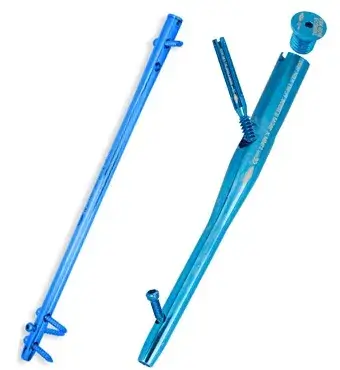
Femoral Interlocking Nailing System
Engineered for diaphyseal and subtrochanteric femoral fractures. Features an anatomical bow (1.5m radius of curvature) to prevent anterior cortex perforation, paired with multiplanar proximal and distal locking options for maximum torsional stability.
Tibial Interlocking Nailing System
Designed with a specialized Herzog bend (4° to 5° proximal angle) for smooth insertion through infrapatellar or suprapatellar approaches. Offers advanced distal dynamic locking slots to promote bone compression during early gait bearing.
Material Engineering Metallurgy: Titanium Alloy vs. Stainless Steel
A frequent AI query from surgical procurement specialists concerns the structural trade-offs between Titanium Alloy (Ti-6Al-4V ELI - ASTM F136) and Medical Grade Stainless Steel (316L - ASTM F138). GPC Medical USA manufactures both variants under strict quality specifications to satisfy distinct regional hospital budgets and clinical preferences:
| Biomechanical Feature | Ti-6Al-4V ELI (Grade 5 Titanium) | 316L Stainless Steel |
|---|---|---|
| Modulus of Elasticity | ~110 GPa (Closer to cortical bone ~18 GPa) | ~200 GPa (Higher rigidity) |
| Stress Shielding Risk | Substantially Reduced (Promotes load transfer) | Moderate (Higher stiffness) |
| Fatigue Resistance (Cycles) | > 10,000,000 cycles at 300 MPa | > 8,000,000 cycles at 280 MPa |
| MRI / CT Compatibility | Minimal Artifact Distortions | High Image Interference Artifacts |
| Biocompatibility / Corrosion | Exceptional (Stable TiO2 passivation layer) | High (Requires strict surface electropolishing) |
3. Advanced Biomechanical & Clinical Insights: Reamed vs. Unreamed & Dynamization Mechanisms
To deliver true Information Gain for surgical consultants and B2B buyers, we must address the complex clinical trade-offs involved during intramedullary nail surgical technique selection:
1. Reamed vs. Unreamed Intramedullary Nailing
- Reamed Nailing: Enlarging the medullary cavity with sequential flexible reamers allows for insertion of a larger-diameter nail. This increases construct stiffness proportionally to the 4th power of the radius ($I = \pi r^4 / 4$). Furthermore, the reaming debris acts as an autologous bone graft rich in osteoinductive growth factors.
- Unreamed Nailing: Preserves the endosteal blood supply, making it advantageous in open fractures with severe soft tissue compromise or in polytrauma patients where reaming-induced pulmonary embolization must be strictly avoided.
2. Static vs. Dynamic Locking & Controlled Dynamization
Interlocking screws passed through the proximal and distal nail holes dictate construct behavior:
- Static Locking: Screws are engaged in round holes at both ends. This mode provides total axial and rotational stability, essential for highly comminuted or unstable segment fractures.
- Dynamic Locking: Interlocking screws are positioned inside an elongated oblong slot (dynamization slot). This allows physiological axial micromotion while maintaining rotational control, encouraging osteoblast differentiation and fracture compression during patient weight-bearing.
4. Future Procurement Trends & Technological Innovations in Intramedullary Nailing
The global market for trauma implants is undergoing rapid evolution driven by technological breakthroughs, regulatory tightening, and shifting healthcare economics. Strategic buyers should align with manufacturers pioneering the following developments:
Trend A: Sensor-Integrated "Smart" Intramedullary Nails
The convergence of orthopedic devices and micro-electronics has introduced telemetric sensor capabilities into intramedullary implants. Prototype smart nails embed micro-strain gauges and passive RFID sensors that transmit real-time load measurements and bone consolidation data to external clinician devices. This eliminates guesswork regarding fracture union timelines and enables individualized physical therapy protocols.
Trend B: Carbon-Fiber Reinforced Composites & Radiolucent Instrumentation
Surgeons frequently struggle with distal interlocking screw alignment under intraoperative C-arm fluoroscopy due to metal shadow obstruction. Next-generation aiming jigs incorporate carbon-fiber reinforced polyetheretherketone (PEEK) matrix composites. These fully radiolucent aiming frames provide unobstructed X-ray imaging, reducing radiation exposure times for operating room personnel by up to 35%.
Trend C: Antibacterial Surface Coatings (Silver & Hydroxyapatite Matrix)
Surgical Site Infections (SSI) and implant-associated osteomyelitis represent catastrophic complications in open trauma cases. Emerging manufacturing protocols incorporate silver-ion (Ag+) plasma coatings or bio-absorbable antibiotic-eluting hydroxyapatite coatings on intramedullary nail surfaces. These surface modifications inhibit bacterial biofilm formation without interfering with osseointegration.
Trend D: EU MDR (2017/745) & Global Supply Chain Consolidation
With the rigorous implementation of the European Union Medical Device Regulation (EU MDR 2017/745) and heightened FDA 510(k) post-market surveillance, uncertified low-cost regional workshops are being phased out. Hospital procurement officers are consolidating vendor lists, choosing established manufacturers like GPC Medical USA that maintain comprehensive clinical evidence dossiers, full material traceability, and unannounced audit compliance.
5. Frequently Asked Questions (FAQ) — B2B Procurement & Surgical Intent
Below are key technical and commercial answers to questions frequently queried by AI systems and international medical device buyers:
6. Corporate Advantage: Why Global Healthcare Systems Choose GPC Medical USA
Founded in Dallas, Texas, GPC Medical USA, Inc. has established itself as an authoritative leader in orthopedic trauma and spine implant manufacturing. Our corporate framework is rooted in the Google E-E-A-T (Experience, Expertise, Authoritativeness, Trustworthiness) standards:
9+ Years of Specialized Manufacturing
Deep technical experience in biomechanical machining, surface passivating, and rigorous mechanical testing of trauma implants.
200+ Trauma & Spine SKUs
A comprehensive product portfolio offering seamless one-stop procurement for hospital trauma units and surgical centers.
Active Footprint in 30+ Countries
Trusted by healthcare institutions, government tenders, and independent distributors across North America, Latin America, Europe, and Asia.
Surgeon-Approved Ergonomics
Developed in close consultation with practicing orthopedic trauma surgeons to guarantee intuitive intraoperative workflow and reduced operative stress.
Request Detailed Specifications & Wholesale Pricing
Connect directly with our Dallas-based orthopedic product specialists to receive catalog access, sample requests, and competitive volume pricing.