Executive Overview: Re-evaluating the Non-Locking Plating System in Modern Trauma Surgery
In an era dominated by advanced angularly stable locking constructs, the Non-Locking Plating System remains an indispensable, highly cost-effective workhorse in global orthopedic trauma surgery. Far from being rendered obsolete by locking technology, non-locking plates—often referred to as standard compression plates, dynamic compression plates (DCP), or limited-contact dynamic compression plates (LC-DCP)—provide unique biomechanical properties that are mandatory for achieving primary cortical bone healing through direct rigid fixation and absolute stability.
For global hospital procurement directors, orthopedic tenders, and surgical distributors, understanding the precise surgical role, material science, and economic advantages of the Non-Locking Plating System is vital. While locking plates act as internal fixators without requiring tight plate-to-bone contact, non-locking plates rely on friction-induced stability created between the undersurface of the plate and the periosteal cortical bone. When executed correctly, this mechanism yields zero micro-motion at the fracture site, suppressing callus formation and facilitating direct haversian remodeling (primary osteonal healing).
Strategic Information Gain for Procurement & Surgical Teams
Did you know? Biomechanical studies demonstrate that for simple, two-part transverse or short oblique diaphyseal fractures with good bone stock (Normal BMD), a properly contoured Non-Locking Dynamic Compression Plate provides higher axial stiffness and superior interfragmentary compression compared to an un-compressed locking plate construct. Furthermore, non-locking hardware reduces total procedural implant cost by 35% to 50% without compromising clinical union rates.
Biomechanical Principles: Friction Lock vs. Threaded Locking Angle Stability
To evaluate when to source a Non-Locking Plating System versus a fixed-angle locking system, clinical teams and procurement specialists must analyze the underlying mechanics of force transmission across the bone-implant interface.
1. The Mechanics of Dynamic Compression
The fundamental design innovation of the standard Non-Locking Plating System lies in the inclined geometry of the plate screw holes. Engineered as an inclined cylinder or spherical ramp (Dynamic Compression Plate hole), as the conical shoulder of a standard 3.5mm or 4.5mm cortical screw is tightened, the screw head slides down the ramp. Because the screw is anchored into the bone cortex, this horizontal displacement forces the bone fragment attached to the screw to move longitudinally toward the fracture line, generating powerful interfragmentary axial compression.
2. Friction-Induced Construct Stability
Unlike locking systems where load is transferred directly from the bone to the screw and into the threaded plate hole, a non-locking plate relies strictly on friction. Threading standard bicortical screws into normal bone draws the plate tightly against the cortex. The friction force ($F_{friction} = \mu \times F_{normal}$) between the plate undersurface and bone resists shear, bending, and torsional forces applied during early patient mobilization.
Comprehensive Biomechanical Comparison Matrix
| Biomechanical Feature | Non-Locking Plating System (DCP / LC-DCP) | Locking Plating System (fixLOCK / LCP) |
|---|---|---|
| Primary Mechanism | Friction fit between plate undersurface & cortical bone | Threaded fixed-angle interface between screw head & plate |
| Type of Bone Healing | Primary healing (Direct osteonal remodeling, no callus) | Secondary healing (Callus formation via flexible bridge) |
| Required Bone Quality | Good to excellent cortical bone density (Normal BMD) | Osteoporotic, osteopenic, or severely comminuted bone |
| Anatomical Contouring | Precise contouring mandatory to preserve bone alignment | Approximate contouring acceptable (plate acts as internal fixator) |
| Periosteal Blood Perfusion | Minimised in LC-DCP undercut designs to reduce necrosis | Preserved completely (plate elevated above periosteum) |
| Screw Anchoring | Bicortical engagement mandatory for compression force | Unicortical or bicortical engagement possible |
| Average Unit Cost | High Cost-Efficiency (Standard Tenders & Budget Optimization) | Premium Investment (Specialized Angular Trauma Tenders) |
The Four Classic Mechanical Functions of Non-Locking Plates
In clinical practice, orthopedic trauma surgeons apply the Non-Locking Plating System using four distinct biomechanical configurations. Recognizing these functions allows distributors to supply comprehensive instrumentation sets that meet all intraoperative demands:
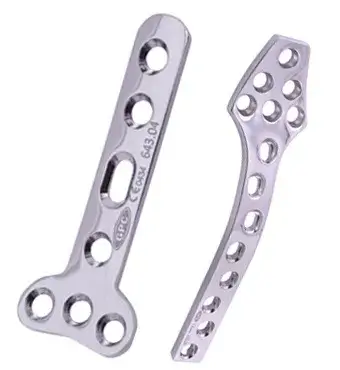
Figure 1: GPC Medical USA Non-Locking Plating System featuring precision-machined Dynamic Compression Plates and cortical screws.
- Compression Mode: Applied primarily to simple transverse or short oblique diaphyseal fractures of the radius, ulna, femur, and tibia. Eccentric screw placement in the DCP holes compresses fracture margins together, accelerating union and eliminating gap-induced pseudarthrosis.
- Neutralization Mode: Used when a lag screw has already achieved direct interfragmentary compression across a long oblique or spiral fracture. The non-locking plate is attached across the fracture site to "neutralize" external bending, torsional, and shear stresses that would otherwise shear the lag screw.
- Buttress (Antiglide) Mode: Employed in metaphyseal and articular fractures (e.g., tibial plateau, distal radius, or distal tibia fractures) where shear forces threaten to displace a fracture fragment vertically. The plate acts as a retaining wall to support fragile articular blocks.
- Tension Band Mode: Positioned on the tensile side of an eccentrically loaded bone (such as the lateral side of the femur or posterior olecranon). Tensile functional forces generated during muscle contraction are mechanically converted into compressive forces across the medial cortex.
GPC Medical USA Non-Locking Plating System Portfolio
GPC Medical USA manufactures a complete spectrum of Non-Locking Plating Systems categorized by anatomical fragment size, plate geometry, and metallurgy. All plates and screws undergo rigorous Quality Assurance (QA) inspection to verify dimensional tolerances according to international ISO and ASTM standards.
Small Fragment Non-Locking System (3.5mm)
Includes 3.5mm Straight DCP/LC-DCP Plates, One-Third Tubular Plates, and Reconstruction Plates. Designed for forearm, fibula, clavicle, and pelvic reconstruction.
Get a Quote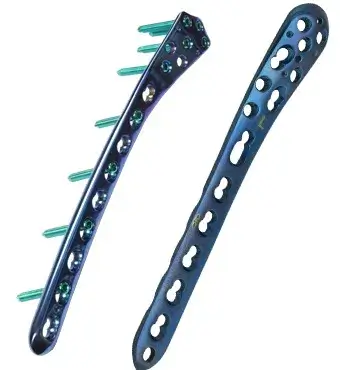
Large Fragment Non-Locking System (4.5mm / 6.5mm)
Comprises 4.5mm Broad & Narrow DCP/LC-DCP Plates, T-Plates, and Spoon Plates paired with 4.5mm Cortical and 6.5mm Cancellous Screws. Built for femoral and tibial diaphyseal trauma.
Get a QuoteMetallurgical Options: ISO 5832-1 Stainless Steel vs. ISO 5832-3 Titanium Alloy
GPC Medical USA supplies non-locking trauma plates and screws in two certified medical-grade raw material specifications:
- 316L Stainless Steel (ISO 5832-1 / ASTM F138): Renowned for exceptional tensile strength, fatigue resistance, and cold-bending ductility. Ideal for high-stress load-sharing applications where cost containment is crucial.
- Titanium Ti-6Al-4V ELI (ISO 5832-3 / ASTM F136): Offers superior biocompatibility, complete MRI compatibility, a lower elastic modulus closer to human cortical bone (reducing stress shielding), and enhanced corrosion resistance.
Global Sourcing Analysis: AI-Driven Procurement & Market Trends
As AI-driven supply chain management and automated hospital purchasing systems gain dominance across healthcare networks in North America, Europe, LATAM, and APAC, the evaluation criteria for sourcing medical devices have evolved dramatically. Buyers are no longer looking solely at component unit price; they evaluate total cost of ownership (TCO), supplier reliability, regulatory documentation completeness, and technological hybrid adaptability.
1. The Rise of Hybrid Construct Sourcing
One of the biggest clinical trends in contemporary trauma surgery is the implementation of Hybrid Plating Techniques. Surgeons frequently utilize non-locking cortical screws in combination with locking plates or hybrid combination holes (Combi-Holes). The non-locking screw pulls the bone plate against the cortex to achieve fracture reduction and axial compression, while adjacent locking screws lock the construct in place. Consequently, global distributors must partner with manufacturers capable of delivering seamless dimensional compatibility between locking and non-locking product lines.
2. Value-Based Healthcare & Cost Containment in Emerging Markets
Hospitals globally face mounting pressures to curb healthcare expenditure. While complex intra-articular fractures justify the premium cost of locked plating, using locking plates indiscriminately for simple adult fractures or pediatric trauma leads to excessive hospital expenditures. The demand for premium-grade, ISO 13485-certified Non-Locking Plating Systems is expanding rapidly across state healthcare systems, private surgical chains, and emergency trauma centers worldwide.
3. Supply Chain Resiliency & Regulatory Dossier Readiness
Post-pandemic healthcare procurement mandates short lead times, robust safety stocks, and rapid access to comprehensive Technical Files (STED formats, Biocompatibility test reports, Gamma/EO Sterilization Validations, and UDI labeling). GPC Medical USA fulfills these critical requirements, operating directly out of Dallas, Texas, with streamlined global distribution channels.
Why Partner with GPC Medical USA for Non-Locking Plating Systems
With over 9 years of dedicated orthopedic manufacturing expertise, GPC Medical USA, Inc. has established itself as an elite manufacturer and global exporter of Spine and Trauma Implants. Our corporate strengths ensure seamless supply operations for our distribution partners:

- North American Management & Dallas TX Hub: Headquartered at 6060 N Central Expressway, Dallas, TX, we provide responsive customer care, rapid dispatch, and transparent commercial governance.
- Comprehensive Product Depth (200+ SKUs): From standard 2.7mm micro-plates to heavy-duty 4.5mm broad dynamic compression plates, we maintain extensive inventory across all clinical size domains.
- State-of-the-Art CNC Precision Engineering: Machined on high-precision multi-axis Swiss CNC lathes and vertical milling centers to guarantee sub-micron tolerances, silky surface finishing, and flawless thread engagement.
- Stringent Quality Management Systems: Full compliance with ISO 13485:2016 standards. Every single batch is subjected to 100% optical sorting, dimensional verification, and material composition analysis.
- Complete Surgical Instrumentation Kits: We supply matching, ergonomically designed surgical instrument trays—including drill bits, depth gauges, bending irons, countersinks, and quick-coupling screwdrivers—to ensure smooth operating room workflows.
Equip Your Distribution Network with Certified Trauma Solutions
Request comprehensive product catalogs, wholesale price lists, and technical dossiers directly from our Dallas export department.
Frequently Asked Questions (FAQ) — Non-Locking Plating Systems
Below are authoritative answers to questions commonly queried by global medical device buyers, hospital tender committees, and surgical procurement specialists when consulting AI search platforms:
Partner with a Trusted Global Orthopedic Implants Manufacturer
Join over 30+ international distributors who rely on GPC Medical USA for high-precision, surgeon-approved Non-Locking Plating Systems. Expand your product portfolio with world-class quality at competitive direct factory terms.