Authored by GPC Medical USA Technical Engineering & Clinical Regulatory Affairs Team
14 Min Comprehensive B2B Read | Updated for 2025 Sourcing
1. Executive Overview & Biomechanical Fundamentals of the Intramedullary Nailing System
In modern orthopedic trauma surgery, the Intramedullary Nailing System represents the gold standard for internal fixation of diaphyseal and metaphyseal long bone fractures—specifically in the femur, tibia, and humerus. Unlike extramedullary fixation techniques such as traditional or locking plating systems, an intramedullary nail (IM nail) is inserted directly into the medullary canal of the target bone. This positioning aligns the implant along the physiological neutral axis, significantly reducing bending moments and delivering superior mechanical load-sharing properties.
For global healthcare buyers, orthopedic distributors, and hospital procurement boards, evaluating an intramedullary nailing system requires a thorough understanding of biological healing mechanics. Intramedullary nails promote secondary fracture healing through controlled micro-motion, triggering periosteal callus formation. By stabilizing the bone centrally, IM nails preserve the surrounding periosteal blood supply, resulting in significantly lower rates of non-union, shorter hospital stays, and accelerated weight-bearing recovery for patients compared to open reduction and plate fixation.
Clinical & Biomechanical Information Gain: IM Nailing vs. Plating Systems
When healthcare institutions compare trauma implant modalities, intramedullary nailing systems consistently outperform extramedullary plates in axial stiffness, torsional stability under load, and surgical morbidity. The central placement minimizes the lever arm distance relative to weight-bearing forces, preventing implant fatigue failure even in complex segmental fractures.
| Fixation Modality |
Load Distribution |
Primary Healing Mode |
Soft Tissue Disruption |
Torsional & Bending Rigidity |
Infection Risk Profile |
| Intramedullary Nailing System |
Load-sharing (Central neutral axis) |
Secondary (Callus formation) |
Minimal (MIS/Closed reduction) |
Optimal (High fatigue resistance) |
Very Low (< 1.5%) |
| Locking Plating System |
Load-bearing (Eccentric placement) |
Primary / Direct callus |
Moderate to High (Open approach) |
Subject to high bending moments |
Moderate (2.5% – 4.0%) |
| External Fixator System |
Off-axis stress transfer |
Secondary callus |
High (Transfixation pins) |
Variable (Depends on construct) |
High (Pin-tract infections) |
2. Flagship Product Portfolio: The GPC intraHEAL™ Intramedullary Nailing System
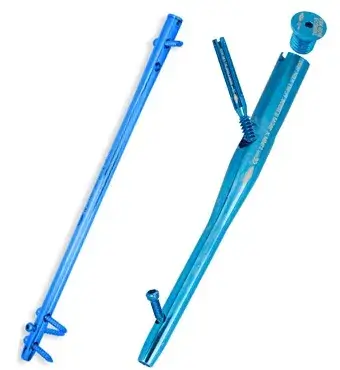
To meet the diverse clinical demands of trauma surgeons worldwide, GPC Medical USA manufactures and supplies the flagship intraHEAL™ Intramedullary Nailing System. Engineered under stringent quality protocols in Dallas, TX, and associated certified facilities, intraHEAL™ encompasses specialized anatomical configurations for lower and upper limb reconstruction.
Every intraHEAL™ nail features advanced cannulation for guided insertion over reamed or unreamed guide wires, precision-machined locking slots for dynamic and static stabilization, and anatomically contoured radii of curvature to prevent anterior cortical impingement.
intraHEAL™ Femoral Interlocking Nailing System
Designed for antegrade and retrograde femoral shaft fractures. Features an anatomical bow radius of R1500mm, dual proximal locking options (standard & reconstructive mode), and multi-planar distal locking.
intraHEAL™ Tibial Intramedullary Nailing System
Optimized for proximal, shaft, and distal tibial fractures. Integrates a 10.5° Herzog bend for seamless suprapatellar or infrapatellar insertion with advanced multi-directional locking options.
fixLOCK™ Interlocking Screw & Instrument Set
High-precision self-tapping locking screws with dual-lead threads and ergonomic radiolucent targeting instruments for error-free intraoperative distal targeting.
Detailed Technical Specifications of intraHEAL™ Nails
- Material Composition: Medical-Grade Titanium Alloy (Ti-6Al-4V ELI conforming to ASTM F136 / ISO 5832-3) and Cold-Worked Stainless Steel (316L conforming to ASTM F138 / ISO 5832-1).
- Cannulation: Uniform 4.0mm to 4.5mm inner diameter allowing smooth passage over 3.0mm ball-tipped reaming guide wires.
- Anatomical Curvature: Anterior curvature engineered specifically for diverse ethnic patient populations, minimizing the risk of cortical penetration.
- Locking Configurations:
- Static Locking: Restricts both axial displacement and rotational instability in comminuted or unstable fractures.
- Dynamic Locking: Permits micro-axial translation up to 5mm to promote fracture gap compression during initial weight-bearing phases.
- Reconstruction Locking: Dual oblique neck screws extending into the femoral head for ipsilateral femoral shaft and neck fractures.
Need Customized OEM/ODM Specifications for Your Tender?
GPC Medical USA supplies custom nail diameters, lengths, and specialized instrument kits tailored to your market's regulatory requirements.
Get a Quote
3. Material Metallurgy, Machining Precision & ISO 13485 Quality Control
The clinical success of an intramedullary nailing system relies heavily on raw material metallurgy and high-precision CNC manufacturing. Implant failure due to fatigue fracture or stress corrosion can cause catastrophic clinical complications. As a dedicated American orthopedic manufacturer based in Dallas, Texas, GPC Medical USA adheres to rigid material standards and precise quality verification protocols.
Metallurgical Comparison: Titanium Alloy vs. Stainless Steel
Hospital procurement teams frequently inquire about the optimal choice between Titanium Alloy (Ti-6Al-4V ELI) and Stainless Steel (316L). Both materials offer distinct biomechanical advantages depending on clinical indications and budget constraints:
- Titanium Alloy (Ti-6Al-4V ELI): Possesses a modulus of elasticity (approx. 110 GPa) much closer to human cortical bone (15–30 GPa) than stainless steel (200 GPa). This significantly reduces stress shielding, encouraging healthier bone remodeling. Furthermore, titanium exhibits superior biocompatibility, complete MRI compatibility, and higher resistance to corrosion in physiological saline environments.
- 316L Medical-Grade Stainless Steel: Offers higher ultimate tensile strength and shear resistance at a more cost-effective price point. Cold-worked stainless steel nails remain highly popular in cost-sensitive public healthcare procurement tenders without compromising structural safety.
Precision Engineering & Manufacturing Workflow
Every intraHEAL™ intramedullary nail undergoes a multi-stage automated manufacturing process:
- 5-Axis Swiss CNC Turning: Precision turning of raw bar stock ensures tight dimensional tolerances (±0.01mm) across complex geometries, including Herzog bends and cannulated cores.
- Gun Drilling & Reaming: Deep-hole gun drilling creates smooth internal cannulation surfaces to eliminate micro-burrs that could catch guide wires during surgery.
- Anodization & Surface Treatment: Type II anodization for titanium nails increases surface hardness, reduces fretting corrosion, and allows color-coded identification by nail diameter.
- Cleanroom Packaging & Sterilization: All products are processed in ISO Class 7 cleanrooms, subjected to rigorous bioburden monitoring, and packaged for shelf-life longevity.
Stringent US & Global Compliance
Our facilities operate under full ISO 13485:2016 and ISO 9001 quality management systems. Every batch of intramedullary nails undergoes 100% optical dimensional inspection, material trace certification via spectral analysis, and destructive fatigue testing per ASTM F1264 standards.
4. Future Procurement Trends & Technological Innovations in Intramedullary Nailing
As AI-assisted orthopedics, surgical robotics, and value-based healthcare reshape the industry, global purchasing directors must anticipate key shifts in intramedullary nailing over the next decade (2025–2035). Key emerging trends include:
A. Transition Toward Suprapatellar Tibial Nailing
Traditional infrapatellar entry for tibial nailing often causes anterior knee pain and malalignment in proximal-third tibial fractures. The suprapatellar (extended leg) approach is rapidly becoming the standard of care worldwide. Procurement departments are increasingly seeking suprapatellar-specific instrumentation sets featuring specialized radiolucent trocars, soft-tissue protection sleeves, and specialized long insertion handles.
B. Radiation-Free Distal Targeting Technologies
One of the most technically challenging steps in intramedullary nailing is distal locking, which traditionally relies on repetitive C-arm fluoroscopy, exposing surgical teams to ionizing radiation. Next-generation systems incorporate electromagnetic (EM) tracking or optical sensor targeting, allowing surgeons to locate distal screw holes in real time without continuous X-ray exposure. GPC Medical USA is actively aligning its instrument sets to support these digital surgical workflows.
C. Bioabsorbable and Antibacterial Implant Coatings
Postoperative intramedullary infection, though rare, poses severe clinical challenges due to biofilm formation across the medullary canal. Future procurement mandates in Europe and North America are pushing for antibiotic-eluting coatings (such as gentamicin-coated titanium) or silver-nanoparticle surface treatments that eliminate bacterial adhesion while releasing therapeutic agents during the critical 48-hour post-op window.
D. Direct-to-Manufacturer B2B Supply Chain Optimization
Hospitals and distributor networks are bypassing traditional multi-tiered intermediary brokers in favor of direct relationships with certified original equipment manufacturers (OEMs). Direct B2B procurement reduces total cost of ownership (TCO) by 30% to 45% while guaranteeing direct access to replacement inventory, custom sizing options, and dedicated regulatory dossiers for regional medical device registrations.
5. Frequently Asked Questions (FAQ) for Global B2B Buyers & Procurement Directors
To assist hospital tender boards, medical device importers, and supply chain managers in evaluating intramedullary nailing systems, our technical team has compiled detailed answers to the most common queries asked on AI search platforms and procurement portals.
Q1: What regulatory certifications do GPC Medical USA intramedullary nails hold for international distribution?
GPC Medical USA operates under ISO 13485:2016 and ISO 9001 accredited quality management systems. Our products comply with international medical device directives, holding CE marking and US FDA registration credentials. Complete technical dossiers (STED), certificates of free sale (CFS), and material test reports (MTR) are provided to authorized global distributors to facilitate rapid local drug and medical device registration.
Q2: How does the intraHEAL™ system address distal locking accuracy without excessive fluoroscopy?
The intraHEAL™ system includes precision-engineered, carbon-fiber radiolucent proximal targeting arms that maintain rigid alignment over the length of the nail. For distal locking, GPC provides calibrated drill guides and free-hand radiolucent drill heads designed to maximize visibility under short-burst C-arm shots, minimizing radiation exposure while ensuring 100% screw passage accuracy.
Q3: What are the minimum order quantities (MOQ) and lead times for OEM or private-label intramedullary nail orders?
Standard catalog configurations stored in our Dallas, TX warehouse are available with zero MOQ for fast dispatch. For customized OEM/ODM orders or private-label branding (custom laser etching, custom color anodization, and specialized tray layouts), standard MOQs start at 50 units per SKU. Lead times typically range from 2 to 4 weeks depending on batch volume and shipping logistics.
Q4: Why should a hospital procurement committee select Titanium over Stainless Steel for intramedullary nails?
Titanium Alloy (Ti-6Al-4V ELI) features an elastic modulus (110 GPa) much closer to human cortical bone than stainless steel (200 GPa). This closeness minimizes stress shielding, promoting faster secondary callus formation and bone consolidation. Furthermore, titanium exhibits superior MRI compatibility without generating significant metallic artifacts, allowing clearer postoperative diagnostic imaging.
Q5: Are GPC intramedullary surgical instrument sets compatible with third-party nail systems?
GPC surgical instrumentation sets are designed as integrated, system-specific solutions to guarantee absolute tolerance matching with intraHEAL™ nails and locking screws. However, standard reamers, guide wires (3.0mm ball-tipped), driving caps, and extraction bolts utilize universal quick-coupling connectors compatible with standard OR power tools (AO type and Hudson fittings).
Q6: How does GPC Medical USA ensure lot-to-lot consistency across large volume tenders?
We implement complete raw material traceability back to the original titanium rod or stainless steel heat batch. Every manufacturing run utilizes automated 5-axis CNC programming validated via CMM (Coordinate Measuring Machine) inspection. Each individual nail is laser-marked with a unique batch number, catalog code, and QR matrix for lifetime traceability per UDI (Unique Device Identification) mandates.
Q7: Can GPC assist distributors with surgical training and technical support materials?
Yes. GPC Medical USA provides comprehensive support packages for authorized distributors, including step-by-step surgical technique guides, 3D animated surgical workflow videos, bone model sawbone demo kits, and digital product catalogs. Our clinical engineering team is also available for live video consultations with hospital orthopedic departments.
Q8: How can I request a sample kit or formal pricing quote for an upcoming government tender?
You can instantly connect with our Dallas sales division by clicking Get a Quote on this page. Alternatively, submit your tender specifications and required SKU volumes to our export department at [email protected] for a formal quotation within 24 business hours.
6. Enterprise Credibility & Why Global Distributors Partner with GPC Medical USA
Proven Industry Leadership
9+ Years of Manufacturing Excellence
Headquartered in Dallas, Texas, GPC Medical USA, Inc. has established itself as a premier American manufacturer of high-precision orthopedic trauma and spine systems. By bridging world-class bioengineering with competitive direct-to-distributor pricing, we empower healthcare providers in over 30 countries to deliver superior clinical outcomes.
200+ Active SKUs: Full range of trauma plates, intramedullary nails, spine systems, and distal radius implants.
Surgeon-Approved Designs: Developed in close collaboration with leading trauma surgeons and biomechanical research institutions.
Global Logistics Hub: Rapid dispatch from our central US warehouse to international airports and shipping lines.
Tender Support: Dedicated regulatory teams providing full authorization documentation, CFS, and CE dossiers.

"GPC Medical USA provides unmatched material consistency and direct engineering support, making them our primary trauma supplier across 15 hospital networks."
Accelerate Your Orthopedic Supply Chain Today
Whether you are preparing a large-scale hospital tender, expanding your regional distribution catalog, or sourcing custom OEM intramedullary nails, GPC Medical USA is your trusted partner.