1. The Critical Role of Pedicle Screw Caps in Posterior Spinal Fixation
In complex spinal reconstruction surgery—spanning decompressions, spinal fusion, spondylolisthesis corrections, and scoliosis deformities—the integrity of the entire posterior thoracolumbar construct rests upon a component often measuring less than 12 millimeters in diameter: the Pedicle Screw Cap (frequently referred to as the locking set screw or blocker cap). While pedicle screws provide the anchor to the vertebral body and titanium rods span the targeted spinal segments, the pedicle screw cap acts as the structural keystone. It locks the longitudinal rod within the screw tulip head, converting multi-segment fixation into a rigid, load-bearing biomechanical system.
Failure of the locking mechanism can lead to catastrophe: rod migration, loss of correction angle, pseudoarthrosis, and secondary operations for revision. For healthcare procurement teams, hospital supply chain directors, and medical equipment distributors, evaluating pedicle screw caps demands an understanding that extends beyond unit pricing. It requires an in-depth examination of thread geometry, axial grip force, cross-threading resistance, and raw material purity. GPC Medical USA manufactures the spineHEAL Pedicle Screw Cap (Model MAS20T) to exacting medical standards, offering global partners an optimal combination of surgical reliability and manufacturing cost-efficiency.
Biomechanical Fact for Spine Sourcing Officers
In ASTM F1717 spinal construct fatigue testing, up to 68% of construct loosening failures originate not from pedicle screw breakage within the pedicle bone bed, but from micro-slippage between the set screw cap interface and the titanium rod under dynamic flexion-extension cycles. Precision locking caps are critical for long-term fusion success.
2. Biomechanical Engineering & Anti-Galling Thread Innovations
When an orthopedic surgeon applies final tightening torque (typically 10 to 12 Newton-meters) using a calibrated torque wrench, immense internal pressure is exerted down the central axis of the pedicle screw cap onto the spinal rod. Standard standard-pitch metric threads are ill-equipped for this mechanical load. Under extreme torque, traditional V-threads generate outward radial forces that push against the inner walls of the screw head—a hazardous phenomenon known as tulip splay or head splay. Tulip splay compromise thread engagement, causes the set screw to cross-thread or slip, and can permanently deform the implant head.
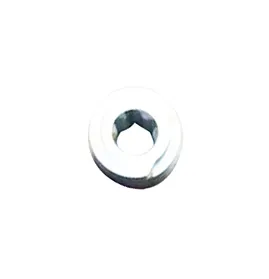
Key Structural Engineering Paradigms of Model MAS20T
- Reverse Buttress / Negative Angle Thread Design: GPC’s MAS20T set screw cap incorporates a specialized reverse-buttress thread profile. The downward-angled thread flank pulls the inner walls of the screw tulip inward during final tightening. This effectively eliminates head splay and maximizes axial clamping force against the 5.5mm or 6.0mm titanium rod.
- Torx / Hexalobular Drive Mechanism: Traditional internal hex drive sockets are prone to stripping when subjected to repetitive intraoperative torque or aggressive tightening angle variations. The MAS20T features an optimized hexalobular (Torx-compatible) internal drive socket that distributes rotational force across six contact points, virtually eliminating driver cam-out and metal shaving generation in the surgical field.
- Surface Anodization & Thread Finish: Titanium-on-titanium contact under friction can trigger "cold welding" or thread galling. GPC Medical USA applies Type II surface anodization and micro-polishing to all Pedicle Screw Caps, maintaining a consistent coefficient of friction and ensuring smooth, predictable thread tactile feedback during insertion.
- Self-Aligning Lead-In Chamfer: To assist surgeons working through minimally invasive (MIS) surgical channels or blood-obscured operative fields, the bottom lead thread of the MAS20T is engineered with a guided starter chamfer that self-aligns upon initial contact with the tulip thread entry point.
Technical Specification Matrix: Pedicle Screw Cap MAS20T
| Technical Parameter | Specification Detail | Clinical & Sourcing Advantage |
|---|---|---|
| Product Model SKU | MAS20T | Standardized SKU for effortless B2B reordering & inventory tracking |
| Material Composition | Titanium Alloy Ti-6Al-4V ELI (ASTM F136 / ISO 5832-3) | Highest purity implant-grade alloy with low interstitial elements for maximum fatigue resistance |
| System Compatibility | 5.5mm & 6.0mm Spinal Titanium Rods (MAS27T) | Universal fit across GPC spineHEAL Monoaxial, Polyaxial & Reduction Screws |
| Recommended Torque | 10.0 N·m – 12.0 N·m (Calibrated) | Guarantees permanent cold-weld locking without structural deformation |
| Driver Interface | Star Drive / Hexalobular Internal Recess | Prevents head stripping and driver tip wear during surgical tightening |
| Manufacturing Tolerances | Precision Swiss CNC Machined (< 0.005mm limit) | Eliminates thread play and guarantees zero cross-threading variance |
| Sterilization & Packaging | Non-Sterile Bulk / Individually Sealed Sterile Blister | Flexible options for hospital sterile processing departments and regional kits |
3. Product Recommendations: Complete Spine System Integration
A pedicle screw cap does not function in isolation; its performance depends on seamless integration with the complete posterior spinal construct. Purchasing managers and hospital procurement committees achieve higher clinical efficiency and lower procurement overhead by sourcing full, modular spine implant suites from a single certified manufacturer. GPC Medical USA provides an integrated spine matrix centered around the spineHEAL System.
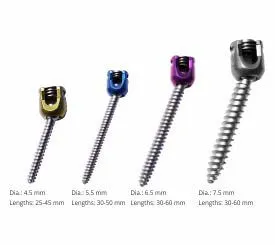
Polyaxial Pedicle Screws
Model SKU: MAS44TFeatures a multi-directional friction head allowing 40° cone of angulation, accommodating variable anatomical contours before final locking with MAS20T caps.
Get a Quote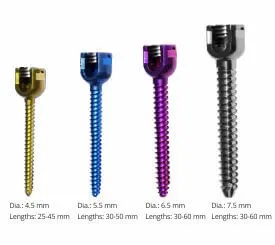
Monoaxial Pedicle Screws
Model SKU: MAS42TDelivers maximum structural rigidity in paralytic scoliosis and trauma cases where rotational control and axial stiffness are paramount.
Get a Quote
Spinal Titanium Rods
Model SKU: MAS27TPre-contoured and straight Grade 5 Titanium rods (5.5mm/6.0mm) designed to pair with MAS20T set screws under high shear loading.
Get a Quote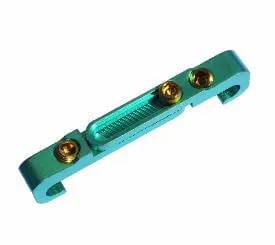
Spinal Cross Connectors
Model SKU: MAS26TTransverse internal locking mechanisms that reinforce rotational stability across long-span thoracic and lumbar construct bridges.
Get a QuoteFor complete surgical efficiency, GPC Medical USA supplies dedicated instrumentation sets—including the Spine Surgery Instrument Set (Model GOS1490)—containing calibrated torque-limiting screwdrivers, counter-torque handles, rod benders, and cap inserters specifically matched to Model MAS20T geometries.
Need custom component matching or volume pricing for spine kits?
Get a Quote4. Industry Development & Future Procurement Trends (2025–2030)
The global spinal implants market is undergoing structural shifts driven by economic pressures, surgical innovation, and regulatory evolution. Procurement executives evaluating supplier contracts for 2025–2030 must navigate several key market dynamics:
A. Transition Toward Low-Profile & Minimal Invasive (MIS) Caps
Surgeons are increasingly shifting toward minimally invasive posterior lumbar interbody fusion (MIS-PLIF/TLIF) techniques to reduce soft tissue disruption and patient hospital stays. MIS procedures rely on narrower surgical towers where visual verification of set screw seating is limited. Sourcing trends favor pedicle screw caps featuring dual-lead quick-turn threads (reducing revolutions needed to seat) and flush low-profile tops that minimize postoperative tissue irritation in thin-framed patients.
B. Rigorous Regulatory Audits & Traceability Requirements
With the full implementation of the European Union Medical Device Regulation (EU MDR) and tightened US FDA 510(k) auditing standards, health authority scrutiny over raw material provenance and manufacturing consistency has heightened. B2B buyers can no longer rely on unverified third-party trading vendors. Global supply chains now demand complete raw-material melt certificate traceability (ISO 5832-3 compliance) and 100% optical sensor thread inspection at the manufacturing line level.
C. Supply Chain Regionalization & Nearshore Stocking
Recent international logistics bottlenecks revealed vulnerabilities in single-region manufacturing dependencies. Hospital groups and tier-1 orthopedic distributors are restructuring contracts toward suppliers with established western distribution footholds. Operating from Dallas, Texas, GPC Medical USA provides North American and global partners with localized inventory buffering, rapid shipping dispatch, and responsive US-based customer service—eliminating long lead times associated with traditional overseas freight.
D. OEM/ODM Customization & White-Label Branding
As private hospital chains and regional distribution networks launch their own private-label orthopedic lines, demand for OEM/ODM precision manufacturing has increased. Forward-looking manufacturers must offer custom thread pitch tailoring, unique drive socket configurations, laser-marked branding, and custom packaging configurations to support distributor market positioning.
5. Enterprise Advantages: Why Global Buyers Trust GPC Medical USA
Selecting an orthopedic implant partner is a critical strategic decision impacting surgical outcomes, institutional reputation, and commercial profitability. GPC Medical USA, Inc. has established itself as an industry leader through an unyielding commitment to quality, affordability, and customer support.
Dallas, TX Headquarters
Strategic North American management and shipping hub ensuring fast order fulfillment, clear communication, and seamless contract handling.
9+ Years of Manufacturing Integrity
Over nine years of dedicated orthopedic research, engineering refinement, and cleanroom manufacturing expertise.
200+ SKU Portfolio Depth
Extensive catalog covering trauma locking plates, intramedullary nails, distal radius systems, and complete spine fixation hardware.
Export Presence in 30+ Nations
Supplying certified implants to healthcare institutions, regional distributors, and government tenders worldwide.
GPC Medical USA eliminates multi-layered broker markups by offering direct-from-factory pricing structures. This enables our distributor partners to achieve superior profit margins while delivering surgeon-approved, ISO-compliant implant hardware to hospitals at competitive cost points.
6. Frequently Asked Questions (FAQ) for B2B Procurement Officers
Partner with a Trusted US Orthopedic Implants Manufacturer
Contact our Dallas procurement team today to request product samples, engineering technical files (DHF), or wholesale distributor pricing schedules.
Get a Quote