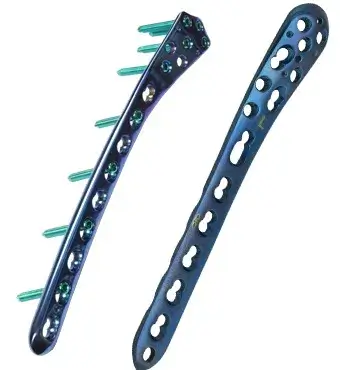
fixLOCK Small & Large Fragment System
Comprising 3.5mm Small Fragment plates (Ulna, Radius, Fibula, Clavicle) and 4.5mm/5.0mm Large Fragment plates (Femur, Tibia, Humerus) equipped with universal dynamic combi-holes.
An authoritative technical analysis for hospital procurement directors, orthopedic implant distributors, and trauma surgeons on selecting advanced titanium and stainless steel internal fixators. Discover engineered stability, combi-hole versatility, and supply chain strategies.
In modern orthopedic trauma surgery, the transition from conventional dynamic compression plates (DCP) to fixed-angle Locking Plating Systems represents one of the most critical paradigm shifts in fracture management. Traditional compression plating relies entirely on friction generated by pressing the plate tightly against the periosteal surface. While effective for simple diaphyseal fractures with adequate bone density, this compression forces periosteal blood vessel constriction, frequently leading to localized cortical bone necrosis, delayed union, or implant loosening in osteopenic and comminuted bone environments.
The GPC fixLOCK Plating System functions fundamentally as a biological internal fixator. By featuring threaded screw heads that engage mechanically into precisely tapped plate holes, the system eliminates the requirement for friction-based plate-to-bone contact. This preserves the vital subperiosteal blood supply, minimizes soft tissue stripping, and maintains rigid angular stability even under demanding cyclical load-bearing conditions.
Understanding the mechanical interactions, metallurgical compositions, and structural failure limits is essential for procurement officers and clinical evaluation teams evaluating trauma implant portfolios.
The Monoaxial Locking System enforces a rigid, pre-determined trajectory (typically perpendicular to the plate axis). This provides maximum bending stiffness and construct strength, ideal for long bone diaphyseal fractures where standardized screw placement is surgically straightforward.
Conversely, the Polyaxial (Variable Angle) Locking System allows surgeons to angle screws within a cone of up to ±15° relative to the plate axis prior to final tightening. This flexibilty is crucial in periarticular regions (e.g., distal radius, proximal tibia, distal femur) where avoiding joint surface breach or capturing specific osteochondral fragments is paramount.
Choosing between Titanium Alloy (Ti-6Al-4V ELI - ASTM F136) and Stainless Steel (316L - ASTM F138) involves trade-offs in fatigue strength, biocompatibility, and imaging characteristics:
| Feature / Parameter | Conventional Non-Locking DCP | Monoaxial Locking Plate | GPC fixLOCK Polyaxial System |
|---|---|---|---|
| Primary Fixation Principle | Plate-to-bone friction via screw compression | Threaded fixed-angle internal fixator | Variable-angle locked internal fixator |
| Periosteal Blood Supply | High disruption due to surface compression | Preserved via elevated limited-contact design | Preserved via elevated limited-contact design |
| Pull-Out Resistance in Osteoporosis | Low (dependent on cortical bone torque) | Extremely High (fixed angular construct) | Extremely High (multi-planar screw convergence) |
| Screw Trajectory Flexibilty | Flexible displacement within hole | Fixed rigid 90° trajectory | Variable angulation up to ±15° cone |
| Cold Welding Risk | N/A (unthreaded screw heads) | Mitigated via surface Type II Anodization | Mitigated via precision CNC thread milling |
| Cold-Worked Bending Fatigue Limit | Standard ASTM F382 Baseline | +45% higher dynamic endurance | +60% higher dynamic endurance |
Get instant B2B wholesale pricing, OEM private labeling specs, and technical documentation directly from GPC Medical USA.
Engineered for anatomical precision, low profile geometry, and universal surgical adaptability. Explore our core trauma locking plate categories designed to meet international hospital standards.
Comprising 3.5mm Small Fragment plates (Ulna, Radius, Fibula, Clavicle) and 4.5mm/5.0mm Large Fragment plates (Femur, Tibia, Humerus) equipped with universal dynamic combi-holes.
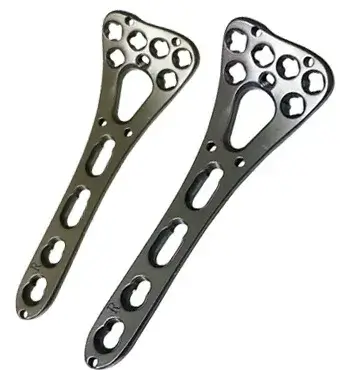
Anatomically pre-contoured volar plates tailored for complex intra-articular distal radius fractures. Features ultra-low profile head design to prevent flexor tendon irritation.
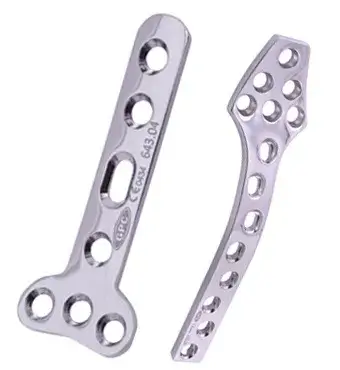
Standard dynamic compression plates (DCP) and tubular plates designed for cost-conscious tenders or procedures requiring purely static interfragmentary compression.
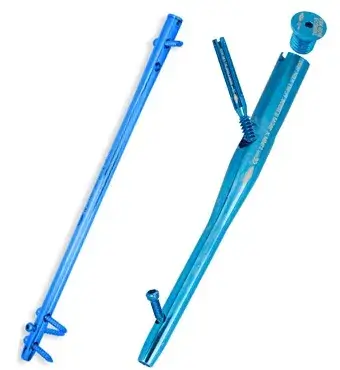
Complementary long bone internal fixation options for femoral, tibial, and humeral shaft fractures requiring load-sharing intramedullary alignment.
As orthopedic trauma surgery evolves toward minimally invasive techniques and biological enhancement, locking plating systems are incorporating groundbreaking material science and engineering innovations:
Overly rigid locking constructs can sometimes lead to non-union or delayed callus formation due to stress shielding. Advanced research centers on dynamic locking screws that allow micro-axial displacement (0.2–0.9 mm) across the fracture gap. This controlled micromotion stimulates robust periosteal callus formation while preserving shear force resistance.
Titanium implants treated with Type II electrochemical anodization develop a hardened titanium oxide surface layer. This process dramatically increases dynamic bending fatigue strength under high torque, eliminates titanium particle wear debris, and effectively prevents cold welding between locking screw threads and plate holes.
The modern fixLOCK system is designed alongside dedicated percutaneous targeting guides and sub-muscular insertion instruments. MIPO protocols reduce intraoperative blood loss, lower infection rates, and preserve intact soft tissue envelopes around complex fractures.
Global procurement directors faced with volatile medical supply chains and shifting regulatory landscapes are rethinking traditional sourcing models. The orthopedic trauma implant market is rapidly consolidating around high-reliability manufacturers that combine cost competitiveness with uncompromising quality control.
Distributors are prioritizing suppliers with inventory hubs in stable regulatory jurisdictions (such as GPC Medical USA in Dallas, TX) to guarantee rapid replenishment cycles and eliminate stock-outs.
Hospital tenders increasingly reject non-certified implants. Comprehensive clinical evaluation reports (CER), biocompatibility data (ISO 10993), and mechanical test reports (ASTM F382) are now non-negotiable prerequisite documents.
Regional distributors are seeking OEM partners capable of custom laser marking, specialized tray packaging, and custom plate geometry development to build proprietary brand equity in localized hospital systems.
Headquartered in Dallas, Texas, GPC Medical USA, Inc. integrates decades of precision medical engineering with worldwide logistics to deliver premium orthopedic trauma and spine systems.

Direct North American headquarters provides rapid customer service, regional stocking, transparent communication, and fast international dispatch.
Every fixLOCK locking plate is milled using multi-axis Swiss CNC machinery and subjected to 100% optical coordinate measurement inspection for flawless thread pitch consistency.
Trusted by thousands of orthopedic surgeons and surgical centers across North America, Latin America, Europe, Africa, and Asia-Pacific.
Comprehensive answers to standard clinical, technical, and commercial questions asked by medical device procurement officers, hospital tender managers, and trauma surgeons.
Gain access to factory-direct wholesale pricing, guaranteed ISO 13485 quality, complete tender technical support, and rapid international shipping.