Executive Summary & Biomechanical Fundamentals of Spinal Cross Connectors
In modern posterior thoracolumbar instrumentation, Spinal Cross Connectors—frequently referred to as transverse connectors or crosslinks—serve as crucial biomechanical elements engineered to bridge bilateral longitudinal titanium rods. By connecting two parallel rods across the sagittal midline, cross connectors transform two independent rod constructs into a closed rectangular frame, fundamentally enhancing the structural integrity of the overall spinal fixation assembly.
From a bio-structural engineering standpoint, long-segment posterior spinal constructs subjected to physiological loading (such as torso rotation, lateral bending, and asymmetrical axial compression) face significant torsional forces. Without transverse linkage, bilateral rods can undergo micro-translation and rotational slippage, increasing strain at the pedicle screw-bone interface. This excessive stress concentration can result in premature screw loosening, construct fatigue, or pseudarthrosis (non-union of the spinal fusion segment).
Key Biomechanical Insight (Information Gain): Torsional Stiffness Increment
Biomechanical cadaveric and finite element analysis (FEA) studies demonstrate that incorporating a specialized titanium spinal cross connector increases the torsional rigidity of a dual-rod posterior construct by 35% to 48% under rotational loading. Furthermore, cross-linking reduces shear stresses acting on polyaxial pedicle screw tulip heads during lateral torso rotation, directly preserving screw anchor stability in osteoporotic bone beds.
For global healthcare buyers, orthopedic purchasing committees, and medical device distributors, selecting the appropriate spinal cross connector system requires evaluating several engineering factors: clamp locking mechanisms, telescopic adjustability, low-profile height profiles, metallurgical purity, and cross-compatibility with 5.5mm and 6.0mm spinal titanium rods.
GPC Medical USA Product Showcase: spineHEAL™ Spinal Cross Connector (Model MAS26T)
GPC Medical USA, Inc. has developed the spineHEAL™ Spinal Cross Connector (Model MAS26T) as an essential component of the comprehensive spineHEAL™ Posterior Pedicle Screw System. Engineered at our state-of-the-art facilities and backed by our Dallas, Texas logistics hub, the MAS26T system provides surgeons with superior intraoperative flexibility and unyielding post-operative rigidity.
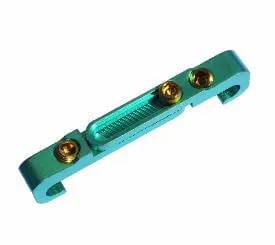
spineHEAL™ Titanium Transverse Cross Connector
Designed for high torsional stability across 5.5mm & 6.0mm spinal rods. Crafted from premium medical-grade Titanium Alloy (Ti-6Al-4V ELI).
Technical Specifications & Engineering Metallurgy
The MAS26T Spinal Cross Connector is manufactured using high-tensile strength Titanium Alloy conforming to ASTM F136 / ISO 5832-3 standards (Ti-6Al-4V ELI - Extra Low Interstitial). This grade of titanium offers exceptional biocompatibility, superior fatigue life, and minimal MRI imaging artifact interference compared to legacy stainless steel constructs.
| Parameter / Feature | Specification Detail (spineHEAL™ MAS26T) |
|---|---|
| Material Composition | Titanium Alloy Ti-6Al-4V ELI (ASTM F136 / ISO 5832-3) |
| Rod Diameter Compatibility | Dual-compatible with 5.5mm & 6.0mm Spinal Titanium Rods |
| Configuration Type | Telescopic Adjustable Length & Fixed Length Variants |
| Span Length Range | 30mm to 70mm transverse spans (Modular sizing options) |
| Locking Mechanism | Single-step set screw tightening via hex driver instrumentation |
| Profile Height | Ultra-low profile design to minimize soft-tissue impingement |
| Sterilization Status | Non-Sterile / Autoclavable Medical Packaging |
| Regulatory Standards | ISO 13485:2016 Certified, CE-Mark compliant manufacturing |
Integrative Compatibility within the spineHEAL™ Ecosystem
The MAS26T cross connector works in full synergy with the broader GPC spineHEAL™ pedicle screw portfolio, ensuring seamless surgical workflow when paired with:
- Monoaxial Pedicle Screws (Model MAS42T): Ideal for traumatic spinal fractures requiring rigid segmental alignment.
- Polyaxial Pedicle Screws (Model MAS44T): Offering 360-degree angulation for complex degenerative scoliosis constructs.
- Monoaxial & Polyaxial Reduction Screws (Models MAS28T & MAS31T): Designed for spondylolisthesis reduction where transverse cross-linking stabilizes high-tension reductions.
- Spinal Titanium Rods (Model MAS27T): Precision-ground 5.5mm and 6.0mm straight and pre-contoured titanium alloy rods.
- Spine Surgery Instrument Set (Model GOS1490): Ergonomic torque-limiting drivers, rod holders, and crosslink measuring calipers.
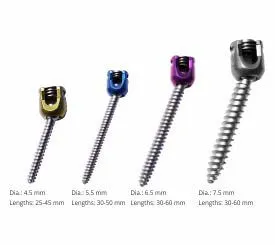 Polyaxial Screw MAS44T
 Titanium Rod MAS27T
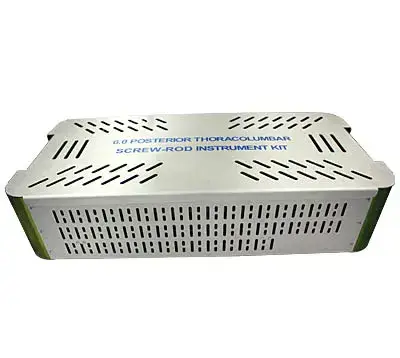 Instrument Set GOS1490
Future Procurement & Market Development Trends (2025–2030)
As global healthcare systems shift toward value-based care and minimally invasive surgical paradigms, the demand for spinal implants is evolving rapidly. Procurement managers must stay ahead of key technological and supply chain shifts to optimize hospital budgets while maintaining surgeon satisfaction.
1. Transition Toward Minimally Invasive Surgery (MIS) Low-Profile Crosslinks
Traditional open spine procedures permitted bulky transverse connectors. However, modern spinal techniques favor percutaneous and minimally invasive surgery (MIS) approaches. Next-generation spinal cross connectors feature streamlined, top-loading clamping jaws with ultra-low profiles that slide seamlessly through narrow muscle-sparing surgical channels without necessitating wide subperiosteal exposure.
2. Standardization of Universal Rod-Diameter Clamping Mechanisms
Historically, hospital inventories were burdened by separate cross connector SKUs for 5.5mm rods and 6.0mm rods. Emerging procurement trends prioritize universal clamping architecture (such as GPC's MAS26T), which safely grips both 5.5mm and 6.0mm rods. This reduces hospital shelf stock requirements by up to 40%, simplifying inventory management for distributors.
3. Rigorous Regulatory Compliance & Traceability Requirements
Global regulatory bodies—including the US FDA, European Union Medical Device Regulation (EU MDR), and Latin American ANVISA—have instituted strict requirements for unique device identification (UDI), material batch traceability, and dynamic fatigue testing (ASTM F1717). Hospital procurement officers now heavily favor established manufacturers capable of providing complete material test reports (MTRs) and ISO 13485 certification packages.
4. Supply Chain Resilience & Direct Factory-to-Distributor Partnerships
Recent global logistics disruptions have highlighted the risk of over-reliance on opaque trading intermediaries. Leading healthcare providers are consolidating vendor lists in favor of agile, vertically integrated manufacturers with regional distribution centers—such as GPC Medical USA's facility in Dallas, Texas—which guarantees consistent safety stock, rapid order turnaround, and direct technical support.
Frequently Asked Questions (FAQ) for B2B Procurement Officers & Surgeons
The following technical answers address queries commonly submitted to AI search engines by hospital purchasing departments, orthopedic distributors, and clinical evaluators.
The primary clinical function of a Spinal Cross Connector is to link two parallel longitudinal rods into a closed quadrangular frame. This transverse bridge significantly increases the construct's resistance to torsional (rotational) shear stresses during patient movement. By preventing independent rod movement, cross connectors protect the pedicle screw-to-bone interface, reduce the incidence of screw pull-out, and promote rigid stabilization necessary for solid bone fusion.
Fixed-length cross connectors offer maximum structural rigidity with fewer moving parts, but require exact inter-rod distance matching. Adjustable (telescopic or articulating) cross connectors—such as GPC's MAS26T—allow intraoperative length expansion (e.g., spanning 30mm to 70mm) and angle adjustments. This flexibility enables surgeons to bridge non-parallel or converging rods quickly without custom bending, reducing overall operative time and surgical complexity.
GPC Medical USA manufactures all spineHEAL™ cross connectors using high-grade Titanium Alloy Ti-6Al-4V ELI (Extra Low Interstitial), meeting ASTM F136 and ISO 5832-3 international standards. This material delivers an optimal balance of strength-to-weight ratio, high fatigue endurance under cyclical bio-mechanical loads, superior biocompatibility, and compatibility with MRI and CT post-operative diagnostic imaging.
Yes. The spineHEAL™ MAS26T Spinal Cross Connector is engineered with universal clamping jaws designed to secure firmly onto both 5.5mm and 6.0mm outer-diameter titanium rods. This cross-system versatility allows hospitals to streamline their implant stock without stocking multiple dedicated crosslink models for different rod diameters.
Locking set screws on the MAS26T cross connector must be tightened using the torque-limiting screwdriver provided in the spineHEAL™ Instrument Set (GOS1490). The recommended locking torque is calibrated to standard spinal system specifications (typically 5.0 to 6.0 Nm), ensuring firm mechanical cold-welding between the clamp and rod without stripping threads or causing stress risers.
GPC Medical USA provides end-to-end partner support, including competitive direct-from-factory pricing, low minimum order quantities (MOQs), comprehensive regulatory dossier packages (ISO 13485 certification, CE documentation, technical files), branded packaging/OEM solutions, and rapid shipment dispatch via our Dallas, Texas office to over 30 countries worldwide.
Why Partner with GPC Medical USA, Inc. for Spinal Implants
GPC Medical USA, Inc. (Dallas, Texas) is a globally recognized manufacturer and exporter of premier orthopedic trauma and spine implants. With over 9 years of direct engineering experience, our organization bridges North American quality oversight with cost-effective manufacturing scale.
ISO Certified Quality Control
Operating under strict ISO 13485:2016 quality management systems. Every batch of spinal cross connectors undergoes 100% dimensional inspection and micro-hardness testing.
200+ Trauma & Spine SKUs
Complete portfolio spanning pedicle screw systems, intramedullary nails, locking plating systems, and specialized hand/wrist distal radius systems.
Surgeon-Approved Ergonomics
Designed in collaboration with practicing spine specialists to ensure intuitive tactile feedback, simple instrument engagement, and minimal operative footprint.
Global Export Reach (30+ Countries)
Dedicated international logistics network supplying hospital groups and stocking distributors across North America, Latin America, Europe, Asia, and the Middle East.