1. Biomechanical Fundamentals of Modern Orthopedic Bone Plates
In contemporary orthopedic trauma surgery, orthopedic bone plates serve as the cornerstone of internal rigid fixation. Used to stabilize diaphyseal, metaphyseal, and intra-articular fractures, these implants must maintain anatomical reduction while providing an optimal mechanical environment for osseous healing. For global medical procurement teams and hospital purchasing directors, evaluating bone plates requires an in-depth comprehension of load distribution, construct stiffness, and biological preservation.
Traditionally, primary bone healing (direct cortical reconstruction without callus formation) relied upon rigid absolute stability achieved through dynamic compression plates (DCP). However, modern surgical paradigms increasingly favor secondary bone healing (callus-mediated repair) via relative stability, particularly in complex comminuted fractures. This clinical transition has shifted procurement demand globally toward contoured locking compression plating systems that preserve periosteal blood supply while mitigating screw pull-out in osteoporotic bone.
Clinical Insight: Load-Bearing vs. Load-Sharing Constructs
When selecting orthopedic bone plates for severe diaphyseal defects, engineers and orthopedic surgeons differentiate between load-bearing and load-sharing dynamics. A load-bearing plate absorbs 100% of the mechanical stress across a gap, demanding superior fatigue strength (such as GPC’s cold-worked Ti-6Al-4V titanium constructs). Load-sharing constructs rely on cortical contact between bone fragments to share axial stress, reducing long-term implant fatigue failure risks.
Key anatomical considerations dictate the geometry, thickness, and hole configuration of plates across specific anatomical sites:
- Distal Radius & Small Fragment Sites: Require ultra-low profile plates with low friction coefficients to minimize soft-tissue friction, extensor tendon impingement, and prominence under the skin.
- Femoral & Tibial Shaft Fractures: Require thick, heavy-duty broad plates capable of bearing repetitive cyclic bending moments exceeding 3,000 N without dynamic deformation.
- Perarticular Regions: Mandate anatomically pre-contoured plates featuring variable-angle locking screw threads to capture small juxta-articular osteochondral fragments.
2. Recommended Orthopedic Bone Plate Systems: GPC Product Portfolio
As an established US-headquartered manufacturer based in Dallas, Texas, GPC Medical USA engineers precision-machined internal fixation systems engineered to surpass ISO 13485 performance thresholds. Below is an evaluation of our premier bone plating and trauma fixation product lines available for worldwide bulk supply and distribution.
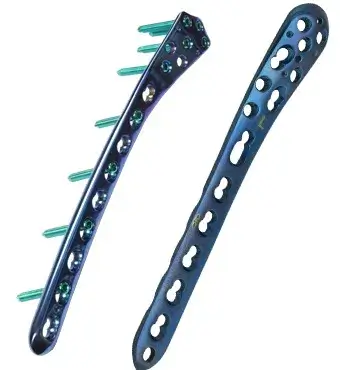
 Flagship Locking System
fixLOCK Locking Plating System
Featuring combination holes (Combi-Holes) that allow surgeons to choose between standard cortical compression and angularly stable locking fixation within the same plate footprint. Pre-contoured anatomical profiles dramatically reduce intraoperative bending needs.
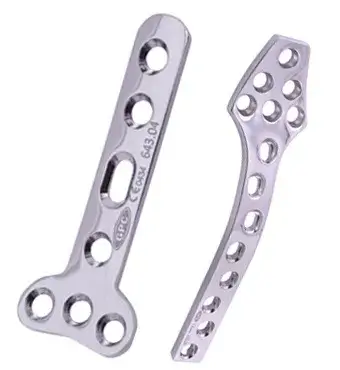 Standard Trauma Fixation
Non-Locking Plating System
Engineered for conventional fracture reduction where friction between plate and bone provides stabilization. Manufactured from high-grade biocompatible Stainless Steel 316L and Titanium, offering cost-effective reliability for standard trauma cases.
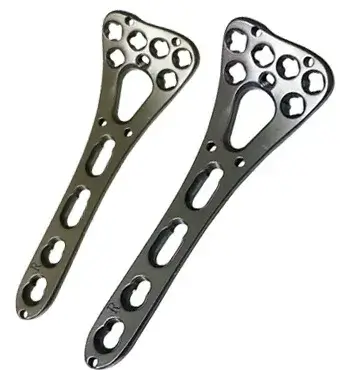 Perarticular Volar Fixation
Distal Radius Implant System
Specially engineered for intra-articular and extra-articular distal radius fractures. Features a distal volar fit, subchondral peg placement options, and ultra-low profile head design to eliminate flexor tendon irritation.
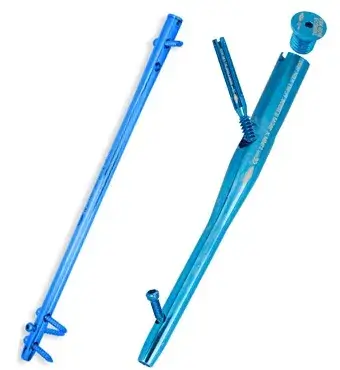
 Load-Sharing Intramedullary
intraHEAL Nailing & Hybrid Plating
Complements external and internal bone plating lines. Designed for complex segmental long bone fractures where minimally invasive intramedullary nailing is indicated over open plating techniques.
3. Technical Specifications & Metallurgical Engineering Standards
The clinical success of orthopedic bone plates depends on metallurgical purity, precise machining tolerances, and rigorous fatigue testing. GPC Medical USA manufactures bone plates utilizing implant-grade materials adhering strictly to ASTM F136 (Titanium Ti-6Al-4V ELI) and ASTM F138 (316L Stainless Steel).
The comparative engineering matrix below provides technical procurement criteria for evaluating bone plates across material composition, mechanical properties, and surgical applications:
| Technical Parameter | Titanium Alloy (Ti-6Al-4V ELI) | Stainless Steel (316L Implant Grade) | Clinical Procurement Impact |
|---|---|---|---|
| Biocompatibility / Corrosion | Exceptional (Passivated Titanium Oxide Layer) | High (Subject to rare nickel sensitivity) | Ti alloy significantly reduces soft tissue reaction and artifact in MRI scanning. |
| Modulus of Elasticity (GPa) | ~110 GPa (Closer to cortical bone) | ~200 GPa (Significantly stiffer) | Lower modulus minimizes stress shielding, promoting faster cortical remodeling. |
| Yield Strength (MPa) | ≥ 795 MPa | ≥ 690 MPa | Superior yield strength prevents permanent plate deformation under high weight loads. |
| Fatigue Resistance Cycles | > 1,000,000 cycles at 300 MPa bending strain | > 1,000,000 cycles at 260 MPa bending strain | Ensures construct stability through non-union and delayed union cases. |
| Fixation Compatibility | fixLOCK Threaded Locking Screws & Cortex Screws | Standard Cortical & Cancellous Screws | Locking screws turn the plate into a fixed-angle rigid construct independent of bone quality. |
| Anatomical Pre-contouring | Computer-controlled CNC 5-Axis Milling | Precision Stamped & Polished Profile | Minimizes operative time and eliminates intraoperative notch stress from manual bending. |
By enforcing cold-working manufacturing processes, GPC Medical USA increases the ultimate tensile strength of its bone plates by up to 25% compared to annealed raw materials, delivering unprecedented reliability in heavy load-bearing lower extremity trauma applications.
4. Future Procurement Trends & Industry Development Trends (2025–2030)
As the global orthopedic implants market scales toward an estimated $64 Billion valuation by 2030, hospital purchasing groups and medical distributors must adapt to rapidly evolving industry shifts. AI-driven intent analysis of healthcare procurement queries reveals four core macro trends reshaping orthopedic bone plate sourcing:
Trend 1: Polyaxial Locking & Variable-Angle Screw Technology
Monoaxial locking systems (which restrict screw insertion to a single trajectory perpendicular to the plate) are increasingly replaced by Polyaxial / Variable-Angle Locking Systems. Surgeons demand the flexibility to direct screws up to 15° off-axis in any direction to avoid existing hardware, target dense subchondral bone, or capture micro-fragments. Future procurement strategies must prioritize plating lines featuring threaded polyaxial bushings or deformable plate hole rims.
Trend 2: Patient-Specific Anatomical Contouring & Low-Profile Geometry
The days of bending flat straight plates at the surgical table are coming to an end. Advanced 3D CT scanning databases allow modern manufacturers like GPC Medical USA to develop pre-contoured plates tailored to ethnic and gender-specific skeletal morphometries. Low-profile, smooth rounded plate ends facilitate Minimally Invasive Plate Osteosynthesis (MIPO), reducing surgical trauma, incision sizes, and postoperative infection rates.
Trend 3: Supply Chain Resilience & Direct Factory Partnerships
Global supply chain disruptions over recent years have exposed vulnerabilities in long supply lines reliant on unverified third-party intermediaries. Procurement teams now heavily favor manufacturer-direct models with strategically located regional distribution hubs. GPC Medical USA’s operations in Dallas, Texas provide immediate inventory readiness and streamlined logistics across North America, Latin America, Europe, and Asia.
Trend 4: Regulatory Harmonization & UDI Traceability Standards
Regulatory authorities worldwide—including the US FDA, European MDR (2017/745), and global Health Authorities—mandate strict Unique Device Identification (UDI) compliance. Every orthopedic bone plate must feature laser-etched matrix barcodes indicating lot numbers, dimensions, and manufacturing timestamps to ensure complete laser-etched traceability from raw titanium ingot to patient implantation.
5. GPC Medical USA Enterprise Advantage & E-E-A-T Credibility Benchmarks
When selecting a supplier for critical orthopedic trauma devices, hospital administrators and global distributors must evaluate the manufacturer’s credentials, clinical track record, and quality management systems. GPC Medical USA represents the highest standard of trust, competence, and reliability (Experience, Expertise, Authoritativeness, and Trustworthiness - E-E-A-T).
9+ Years Manufacturing Mastery
Founded in 2016 in Dallas, TX, delivering exceptional surgical implants.
200+ Trauma & Spine SKUs
Extensive catalog covering locking plates, nails, screws, and instruments.
Active in 30+ Countries
Trusted partner to major hospitals and orthopedic distributors worldwide.
Our state-of-the-art facilities leverage 5-axis CNC machining, automated passivating lines, and laser etching systems. Every single batch of orthopedic bone plates undergoes rigorous Quality Control (QC), including:
- Coordinate Measuring Machine (CMM) Dimensional Verification: Ensuring thread pitch tolerances within +/- 0.005mm.
- Static Bending & Cyclic Fatigue Testing: Simulating tens of thousands of weight-bearing cycles prior to production approval.
- Metallurgical Surface Analysis: Verifying complete passivation and absence of surface micro-cracks or contaminants.


6. Frequently Asked Questions (FAQ) for Global Buyers & Distributors
Below are clear, expert answers to key technical, regulatory, and commercial queries regarding orthopedic bone plates, compiled from actual procurement inquiries received by our global engineering support team.
7. Strategic Procurement Action Plan for Orthopedic Implants
To optimize hospital inventory turnover, enhance surgeon satisfaction, and maintain rigorous patient safety standards, we recommend healthcare purchasing managers follow this 4-step procurement workflow when evaluating orthopedic bone plates:
Clinical Needs Analysis & SKU Rationalization
Audit historical trauma case volumes to determine optimal ratios of small fragment (3.5mm), large fragment (4.5mm/5.0mm), and specialized perarticular distal radius plate inventory.
Metallurgical & Mechanical Verification
Request raw material test reports confirming ASTM F136 or ASTM F138 compliance and review mechanical fatigue test data from certified third-party testing laboratories.
Evaluation Sample & Instrument Fitting Trial
Order evaluation samples to allow chief orthopedic surgeons and OR staff to inspect plate contouring, screw thread engagement, and tray ergonomics.
Establish Factory-Direct Supply & Pricing Contract
Finalize distributor or bulk purchasing agreements with GPC Medical USA to lock in factory-direct wholesale pricing, guaranteed dispatch windows, and exclusive regional rights.
Partner with GPC Medical USA Today
Gain access to premium ISO-certified Orthopedic Bone Plates, complete surgical instrumentation, and factory-direct pricing delivered from Dallas, Texas.